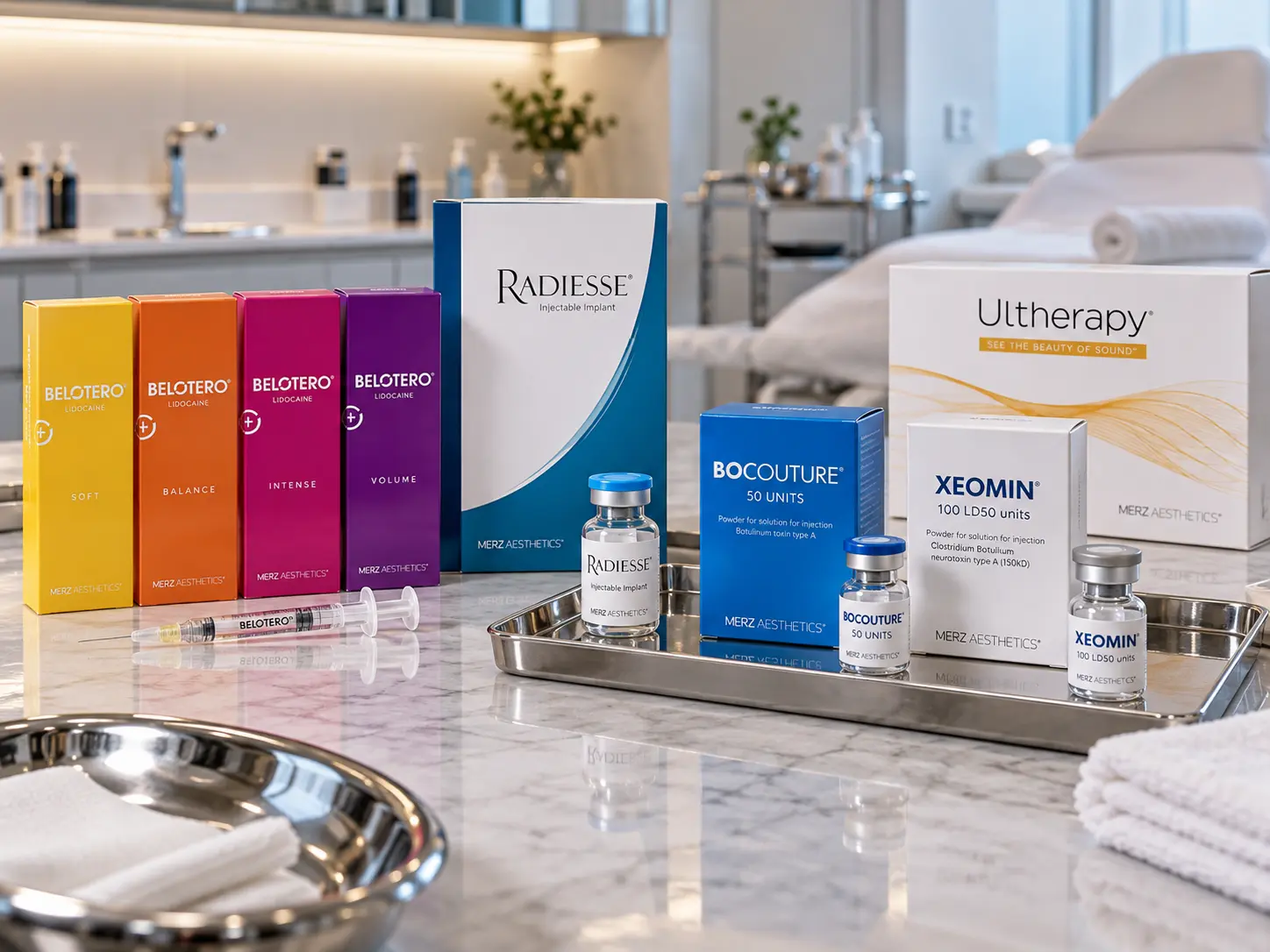
Of the Merz Aesthetics products sold in the UK, only Bocouture is a licensed medicine; the fillers and Ultherapy are regulated as devices. Bocouture, a botulinum toxin type A injection, holds an MHRA marketing authorisation and is prescription-only. Belotero hyaluronic acid fillers, the Radiesse injectable and the Ultherapy ultrasound system sit under medical device law instead. Behind all of them is Merz Aesthetics, the aesthetics business of a Frankfurt group founded in 1908 and still owned by its founding family.
That split decides what anyone can check. A licensed medicine has a public Summary of Product Characteristics (SmPC) stating its indication, its licence numbers and the trial results behind the licence. Devices have nothing equivalent in the public record. What follows sets out what each document says, who owns the UK company, and which rules govern the clinics using these products in England today.
Everything here comes from regulatory and registry records read on 30 October 2026. Nothing is a recommendation of any product, and every trial figure quoted was produced by studies Merz funded.
What does Merz Aesthetics make
Merz Aesthetics makes injectables and energy-based devices for facial and body aesthetics: a botulinum toxin sold in the UK as Bocouture and in the US as Xeomin, the Belotero hyaluronic acid fillers, the Radiesse calcium hydroxylapatite injectable, and the Ultherapy micro-focused ultrasound system. Among these Merz Aesthetics products, only Bocouture is a UK licensed medicine.
On its US-facing product page, Merz lists incobotulinumtoxinA under the Xeomin name and notes it is "also marketed as Bocouture in some countries". Bocouture is the name printed on the UK licence. Therapeutic uses of the same molecule belong to a sister business, Merz Therapeutics, under separate licences, and fall outside this piece.
Recent product news is mostly American. According to the Merz Aesthetics newsroom in Raleigh, North Carolina, the FDA approved Radiesse for wrinkles of the décolletage, announced on 8 April 2026. A knee indication for Ultherapy PRIME followed on 11 August 2026. Premarket approval applications for two Belotero lidocaine fillers went to the FDA on 8 October 2025.
All three are company statements about US decisions. None changes what Merz Aesthetics products may be used for in the UK.
Bocouture and the figures behind the licence
Advertising for aesthetic toxins leans on phrases such as proven results. Bocouture's SmPC, revised on 19 January 2026, is more exact, and it is the document the licence rests on.
The SmPC names the holder as Merz Pharmaceuticals GmbH of Frankfurt. Two UK licences are listed: PL 29978/0002 for the 50-unit vial, first authorised on 29 June 2010, and PL 29978/0005 for the 100-unit vial, first authorised on 8 September 2016. Legal category: POM, prescription-only medicine. Anyone asking which botulinum toxin licence covers this product can read those numbers on the public SmPC.
Its licensed indication is narrower than most marketing implies. In the SmPC's words, Bocouture is for the temporary improvement in the appearance of moderate to severe upper facial lines (frown lines between the eyebrows, crow's feet and horizontal forehead lines) in adults under 65, when their severity has an important psychological impact for the patient. Use outside that wording is off-label.
For frown lines, the SmPC reports a phase 3, double-blind, placebo-controlled trial in which 169 people received Bocouture in the main period. Success meant a rating of none or mild on a 4-point wrinkle scale, judged by the investigator at week 4. According to the SmPC, 51.5% of Bocouture patients met it against 0% on placebo, an absolute difference of 51.5 percentage points.
Two gaps matter. In the passage read, the SmPC does not say whether that measure was the pre-registered primary endpoint, nor how many people took placebo, and neither point was checked against a trial registry for this article.
For crow's feet, a phase 3 trial of 111 people used an independent rater working from standardised photographs at week 4. The SmPC gives success rates of 69.9% against 21.4% on placebo in one treatment scheme and 68.7% against 14.3% in the other: absolute differences of 48.5 and 54.4 percentage points.
Both were Merz studies. A subgroup analysis in the SmPC also notes lower efficacy in people over 50 and in men; those are observations, not results. And because both trials measured appearance at 4 weeks, they say nothing about long-term satisfaction or about areas outside the licence.
The same document is plain about harms. According to section 4.8 of the SmPC, undesirable effects usually appear in the first week and are temporary, and they can come from the toxin, the injection, or both. Localised muscle weakness is listed as an expected effect of the drug class, and a drooping eyelid (blepharoptosis) is linked to the toxin's action and to injection technique. Injection-site reactions such as pain and bruising are listed separately.
Rarer risks are named too. Section 4.4 warns that effects from toxin spreading away from the injection site have been reported with botulinum toxins, very rarely, including swallowing difficulty and aspiration pneumonia, in some cases fatal, mostly in other indications; the SmPC says such effects cannot be completely ruled out with Bocouture.
Caution is advised in people with bleeding disorders or on anticoagulants, and serious allergic reactions, including anaphylaxis, have been reported with the class. Too-frequent treatment can lead to neutralising antibodies and loss of effect, the SmPC adds.
None of that makes the medicine unusual among Merz Aesthetics products or among toxins. It is simply written down, which is the point of a licence.
Medicine or device, why the label matters
Legal status shapes almost everything a patient or a clinic can verify about Merz Aesthetics products, and the two groups compare as follows.
- Bocouture is a medicine. The MHRA licenses it, it needs a prescriber, and its public SmPC states indication, warnings and trial data. Suspected side effects go to the MHRA Yellow Card scheme.
- Belotero, Radiesse and Ultherapy are devices. No SmPC exists for them and no prescription is required in law; their claims rest on device conformity assessment and the manufacturer's instructions for use. Side effects can still be reported through Yellow Card.
Evidence is therefore lopsided. Trial figures for the toxin sit in a licensing document anyone can open. For the fillers and the ultrasound system, a reader depends on instructions for use, published studies and company statements, and a missing SmPC is not the same as a missing risk.
US device decisions, such as the Ultherapy knee indication announced in August 2026, are FDA clearances. They do not establish what any device is marked for in Great Britain, and the marking each Merz device carries here was not confirmed for this article.
Comparisons between brands follow one rule. Botox, from Allergan Aesthetics, is another botulinum toxin type A with its own UK licence. Two toxins mean two licences, and SmPC figures for one cannot be carried over to the other.
Who owns Merz Aesthetics UK
Merz Aesthetics UK Limited, company number 14506945, was incorporated on 25 November 2022 and is active. Companies House records Merz Aesthetics GmbH of Frankfurt as its controlling owner, holding 75% or more of the shares and votes since 1 April 2024. Above that sits Merz, a group owned by the Merz family.
Registry detail fills in what brand pages leave out. Its registered office is Ground Floor Suite B, Breakspear Park, Breakspear Way, Hemel Hempstead, HP2 4TZ, the same address Bocouture's SmPC gives for UK medical information. Its stated business is wholesale of pharmaceutical goods, and its latest filed accounts run to 30 June 2025.
Control changed hands within the group in 2024. Merz Pharma UK Limited (04703428) had been the controlling entity since incorporation and ceased to be so on 13 May 2024, after the German parent was recorded.
Merz's own history page says Friedrich Merz founded the business in Frankfurt on 9 March 1908 and that the fourth generation of his family owns it today. It describes three businesses: Merz Aesthetics, Merz Therapeutics and Merz Consumer Care. That account is a company statement rather than a filed record; the German registration of the UK parent, HRB 123477, is on the UK register.
The UK rules for clinics using these products
England does not yet license clinics that give botulinum toxin or dermal fillers. The Department of Health and Social Care consulted on a licensing scheme for non-surgical cosmetic procedures from 2 September 2023 and published its response on 7 August 2025. On 21 October 2026 it said it "remains committed" to licensing clinics that deliver Botox, lip filler and other lower-risk treatments. No start date was given.
Movement came at the higher-risk end. On that same day the department opened a consultation on draft regulations restricting deep chemical peels and some laser procedures to doctors, dentists and some prescribing nurses, midwives and pharmacists. Fillers injected into the body below the face would become cosmetic surgery, for doctors only. Parliament is due to consider the rules in spring 2027, and fixed penalties of up to £4,000 are proposed. Under-18s are already protected by the Botulinum Toxin and Cosmetic Fillers (Children) Act 2021.
For anyone comparing Merz Aesthetics products at a clinic, two practical points follow from the documents rather than from any brand. Bocouture needs a prescriber, so the person treating should be able to say who prescribed it. Belotero, Radiesse and Ultherapy treatments are device procedures, so asking which product and which batch was used is reasonable, because the batch matters if anything goes wrong.
Decisions about any treatment belong with a qualified clinician or pharmacist, not with a product list.
Some questions stay open on the record. A registry check would show which Bocouture outcomes were pre-registered as primary. Device markings for the other Merz Aesthetics products in Great Britain need confirming with the MHRA or the manufacturer. England's toxin and filler licensing scheme has no date, so the rules described here are those in force on 30 October 2026. Spring 2027 is the next fixed point, when the higher-risk restrictions reach Parliament, and this page will be reviewed by 30 January 2027.