Drug discovery has long been defined by a persistent mismatch between what looks promising in preclinical studies and what ultimately succeeds in patients. A frequently cited headline figure is that around 90% of drug candidates do not make it through clinical trials, with failure often attributed to safety signals, unexpected toxicity, or pharmacokinetic behaviour that was not predicted earlier. In 2026, London-based innovators are positioning microbiome-on-a-chip systems as a practical response to that translational gap, particularly where gastrointestinal toxicity and metabolic interference are central risks.
The proposition is specific. Rather than relying on animal models or simplified cell cultures, researchers are attempting to recreate the human gut environment in a controlled microfluidic device, preserving key features such as oxygen gradients, barrier function, microbial metabolism, and mechanical strain. The stated benefit for researchers and developers is improved prediction of human-relevant absorption, metabolism, and toxicity, with a parallel ethical aim of reducing reliance on animal testing.
Why animal models miss gut toxicity and metabolism signals
The central limitation of animal models in gastrointestinal pharmacology is not effort or sophistication, but biological divergence. Mouse gut anatomy differs from human anatomy, and microbial diversity, composition, and metabolic capacity vary substantially across species. Even when protocols are tightly controlled, the microbial context that shapes drug biotransformation in humans cannot be assumed to exist in murine systems.
This matters because the gut is not a passive conduit. It is a dynamic interface between ingested compounds, host cells, immune signalling, and microbial metabolism. Where an intervention is systemically administered, the gastrointestinal environment still influences exposure through bile acids, enterohepatic cycling, immune activation, and microbial enzymatic activity. Where an intervention is orally administered, the gut environment is the first major determinant of whether the active ingredient reaches systemic circulation intact.
In the framework described here, the translational gap is amplified when a candidate appears tolerable in animals but triggers intolerance, barrier disruption, or unexpected metabolites in humans. The claim for organ-on-a-chip approaches is that they offer a human-relevant model for these interactions without the confounding species differences that dominate conventional preclinical steps.
What a microbiome on a chip is and why microfluidics matter
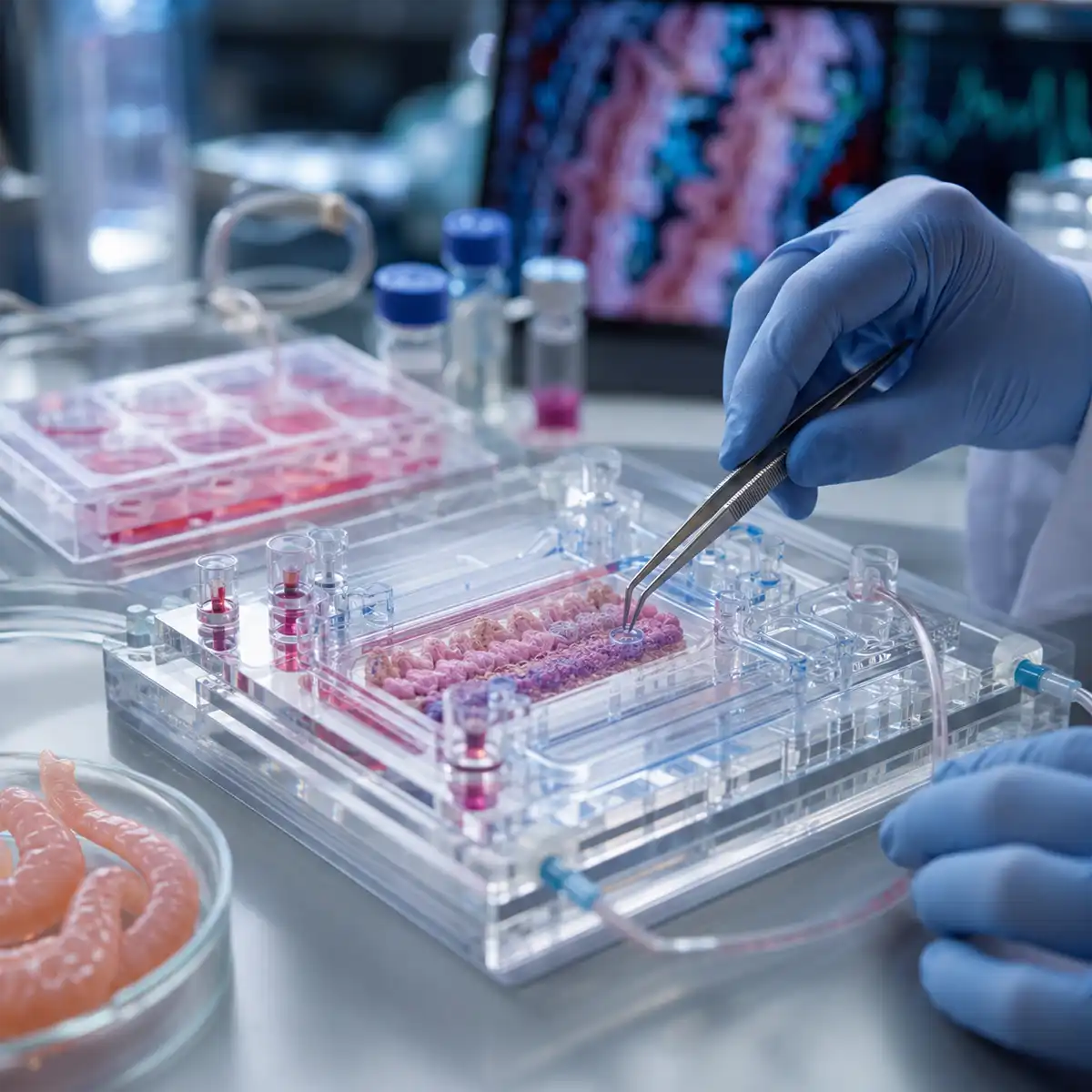
A microbiome on a chip is presented as a microphysiological system that uses microfluidic channels to reproduce selected physical and biological features of the human gut. The concept extends beyond static co-culture. The device is designed to support living human intestinal cells and anaerobic gut bacteria in close proximity while maintaining their different oxygen requirements.
A defining technical feature is the oxygen gradient. Human intestinal epithelial cells, which are typically oxygen-tolerant, can be supported on one side of a semipermeable membrane under conditions that preserve viability and barrier function. Anaerobic bacteria, which are oxygen sensitive, can be supported on the opposite side where oxygen tension is kept low. This arrangement aims to preserve a more realistic host-microbe interface than standard culture systems.
Microfluidics is not an aesthetic choice. It provides controlled flow, stable gradients, and repeatable exposure conditions. For pharmaceutical development, those elements matter because they allow timed dosing, sampling of effluent, and observation of barrier changes under conditions that resemble physiological perfusion rather than a single bolus exposure in a dish.
Why is mechanical strain treated as a core variable?
The article describes vacuum driven motion that produces peristalsis-like strain. This element is included because intestinal tissue is not static in vivo. Mechanical forces influence differentiation, mucus production, and barrier behaviour. Without strain, epithelial layers can behave differently, including altered tight junction characteristics and atypical mucus architecture.
In this framing, mechanical motion is positioned as essential to achieve the level of physiological fidelity needed for drug interaction experiments. The intended outcome is not simply cell survival, but a mucosal barrier that behaves more like a living gut, including measurable responses to bacterial metabolites, inflammatory triggers, and drug exposure.
This is also presented as the basis for real-time observation. By combining controlled flow, strain, and compartmentalisation, a microbiome on a chip is positioned to show how a molecule interacts with the mucosal surface while microbial communities metabolise compounds in parallel.
How microbiome metabolism reshapes ADME predictions
The microbiome is described as a virtual organ because it can chemically modify drugs and drug-like compounds before they reach systemic circulation. Within this article’s framing, that capability is a primary reason conventional preclinical models underperform in predicting human outcomes.
Microbial transformation can reduce efficacy by deactivating active compounds or increase risk by generating metabolites with higher toxicity. This is not limited to oral medicines. Microbial metabolism can influence host pathways that affect drug distribution and clearance, including modulation of bile acids and inflammatory tone.
The proposed advantage of ADME testing on a microbiome on a chip is the ability to observe transformation and barrier passage within a controlled human cell and human microbiota interface. The article also describes a personalised angle, where a patient’s own microbiota could be used to test interactions relevant to that individual. In a clinical research setting, this is positioned as a route towards more precise prescribing and improved stratification of risk.
Real fact: The gut microbiome is increasingly treated as a functional organ in drug development because microbial metabolism can alter drug exposure and toxicity.
Why personalised microbiota testing is being explored
The article highlights the potential to test interactions using a patient’s own microbiota. In this framing, the value lies in capturing inter-individual variation that is often washed out in averaged models. If microbial composition determines whether a compound is activated, deactivated, or converted into a problematic metabolite, then population averages may not identify the subgroups most likely to benefit or to experience harm.
A microbiome on a chip platform offers an experimental pathway for such questions. The same compound can be run against distinct microbial communities under the same dosing and flow conditions, allowing investigators to separate drug effects from microbiota-driven variability. For clinical development, this could inform inclusion criteria, safety monitoring plans, and biomarker selection. For pharmacists and prescribing scientists, it suggests a future in which microbial context becomes part of the risk assessment for certain classes of medicines.
The article’s claims remain directional rather than definitive. It does not present validated clinical algorithms, but it positions the technology as a bridge between microbiome science and applied pharmacology.
How these systems are framed as replacements for murine models
Replacing murine models is presented as both a scientific and ethical goal. The scientific argument is rooted in human relevance. Where murine anatomy and microbial diversity diverge from humans, a human cell and human microbiota platform can be designed to represent human biology more directly.
The article states that these platforms have already outperformed animal benchmarks in predicting liver and intestinal injury. In a neutral framing, the core point is that organ-on-chip systems are being positioned as competitive comparators for specific endpoints, especially those linked to barrier function, inflammation, and metabolism.
For drug development pipelines, this does not necessarily mean that animal testing disappears immediately across all stages. It does suggest a narrowing of where animal models are treated as indispensable, particularly as regulatory frameworks encourage validated alternatives and as platform reproducibility improves.

Why London is positioned as a catalyst for NAM adoption
London is described as a leading destination for New Approach Methodologies. The article locates this activity within the Golden Triangle and the Knowledge Quarter around King’s Cross, including institutions and incubators that attract translational programmes and early-stage companies. The stated driver is a convergence of lab capability, data infrastructure, and proximity to NHS clinical networks.
A second driver described is capital allocation into life sciences innovation, including a reported £2.9bn venture capital influx into AI and machine learning life sciences. Within the article, this funding is presented as a catalyst for combining organ-on-chip outputs with predictive modelling, producing an integrated in silico plus in vitro development loop.
The practical implication is a more iterative preclinical workflow. Data from chip experiments can be used to refine hypotheses, adjust candidate selection, and inform dosing strategies before clinical trial initiation. In the best case, this reduces time to the clinic by eliminating candidates likely to fail later. In the worst case, it still provides higher resolution signals earlier in development, supporting better-informed go or no-go decisions.
How organ-on-chip data is being linked to predictive modelling
The article’s modelling claim is not that algorithms replace experiments, but that they become more accurate when trained on human-relevant biological data. Organ-on-chip platforms generate time series outputs such as barrier integrity measures, metabolite profiles, inflammatory markers, and viability signals under controlled dosing conditions.
In the described London ecosystem, these outputs feed machine learning pipelines that attempt to predict downstream outcomes such as toxicity risk, exposure variability, and mechanism-linked adverse events. The central point is a shift in the evidentiary substrate used for prediction, from animal-derived proxies to human-relevant experimental data.
For professional audiences, the methodological question becomes how well these models generalise, what validation standards are used, and whether the combined system reduces uncertainty sufficiently to change development decisions. The article positions London as a site where this integration is being operationalised rather than remaining conceptual.
What the UK regulatory roadmap is claimed to change in 2026
The regulatory section describes a decisive shift in November 2025, when a Strategic Roadmap for replacing animal testing was announced, alongside £75 million in funding and the establishment of a UK Centre for the Validation of Alternative Methods. This is presented as a state-backed commitment to accelerate validation and adoption of non-animal methodologies.
The article then highlights specific milestones for 2026. These include a move towards mandating non-animal approaches for skin and eye irritation assessment for new treatments, adoption of DNA-based methods for detecting adventitious agents in medicines, and leadership in global standardisation so that organ-on-chip data generated in the UK is acceptable to international regulators.
In a neutral, evidence-first framing, the key implication is alignment. Drug developers are more likely to invest in organ-on-chip workflows if regulatory expectations increasingly reward validated non-animal approaches, and if standardisation allows data portability across jurisdictions.
Standardisation and acceptance across regulators
Standardisation is presented as the enabling condition for international acceptance. Organ-on-chip systems vary by design, cell source, microbial composition, flow parameters, and readouts. Without agreed performance standards, it is difficult for regulators to interpret results consistently or compare outputs across platforms.
The article positions the UK as driving harmonisation so that chip-generated evidence has regulatory value beyond the UK. For pharmaceutical professionals, this is not a purely technical issue. It shapes investment decisions, trial sequencing, and dossier strategy. If regulators in multiple regions accept comparable datasets, developers can reduce duplication and accelerate global development plans.
The 3Rs in a modern economic argument
The ethical rationale is anchored in the 3Rs: replacement, reduction, and refinement. The article argues that microbiome on chip approaches support replacement, where human-relevant systems can substitute for animal testing, reduction, where fewer animals are needed, and refinement, where remaining animal studies are better targeted and less burdensome.
The economic argument is linked to preclinical attrition. If candidates fail earlier, fewer resources are spent on compounds unlikely to succeed. The article frames this as a route to lower R and D waste and potentially improved affordability for innovative therapies within the NHS.
This is an aspirational projection rather than a quantified cost model. However, the logic is coherent within the article’s structure. Reducing late-stage failure is presented as both an ethical gain and a strategic gain, especially in therapeutic areas where toxicity signals emerge late and impose substantial sunk costs.
Conclusion
Microbiome on a chip platforms are being positioned as a practical response to a longstanding problem in drug development, the poor predictability of human gastrointestinal toxicity and metabolism using conventional models. In the London ecosystem described here, microfluidic systems that preserve oxygen gradients, barrier function, and mechanical strain are treated as a higher fidelity experimental substrate for drug discovery, especially when paired with computational models that learn from human-relevant data.
The UK policy direction outlined in the article suggests that regulatory and validation frameworks may increasingly support these approaches, reinforcing the shift from animal-centred preclinical pipelines towards validated alternatives. For researchers and pharmaceutical professionals, the most immediate value is not a claim of perfect prediction, but a reduction in uncertainty at the point where decisions are most expensive.
If animal testing has historically been the lantern carried through the preclinical tunnel, microbiome on a chip technologies are being presented as a set of brighter instruments, closer to the terrain they aim to map.