BPC-157 is a synthetic peptide marketed online as a repair aid for damaged tendons, ligaments and gut tissue. It is not approved as a medicine in the United Kingdom, the European Union or the United States, and it has been prohibited in competitive sport since 2022. The interest is real, and the question that brings most readers here is simple. Does it actually heal tendons in people. The honest answer, as of 2026, is that the human evidence needed to say so does not yet exist. Almost all of the supporting data comes from rodents. One small human study has been published, and no controlled trial has tested whether the peptide repairs human tendons. That gap sits awkwardly against a wave of online promotion and a United States regulatory vote in July 2026 that has been widely misread as approval. This article separates what has been shown from what has been claimed.
What BPC-157 is claimed to do for tendons
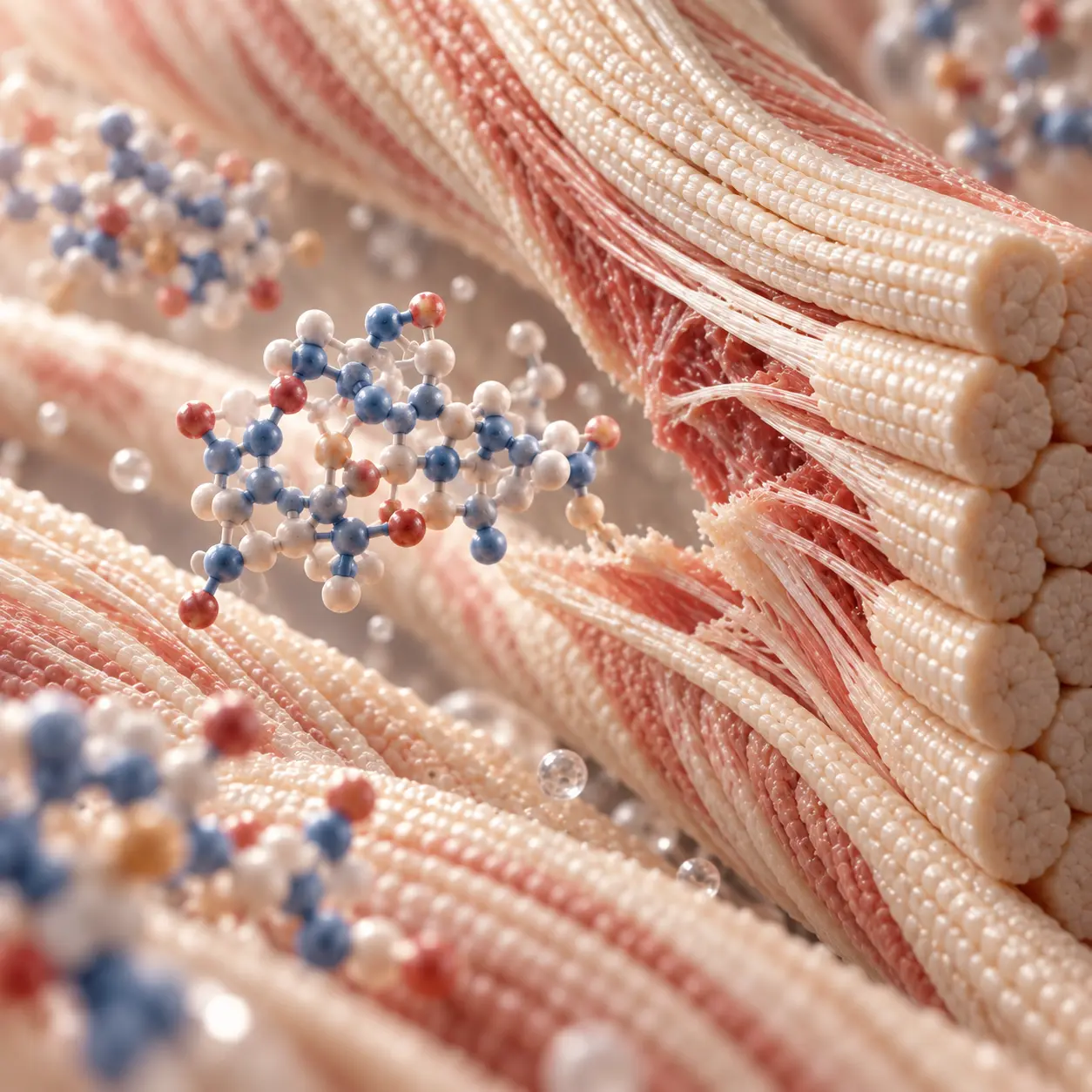
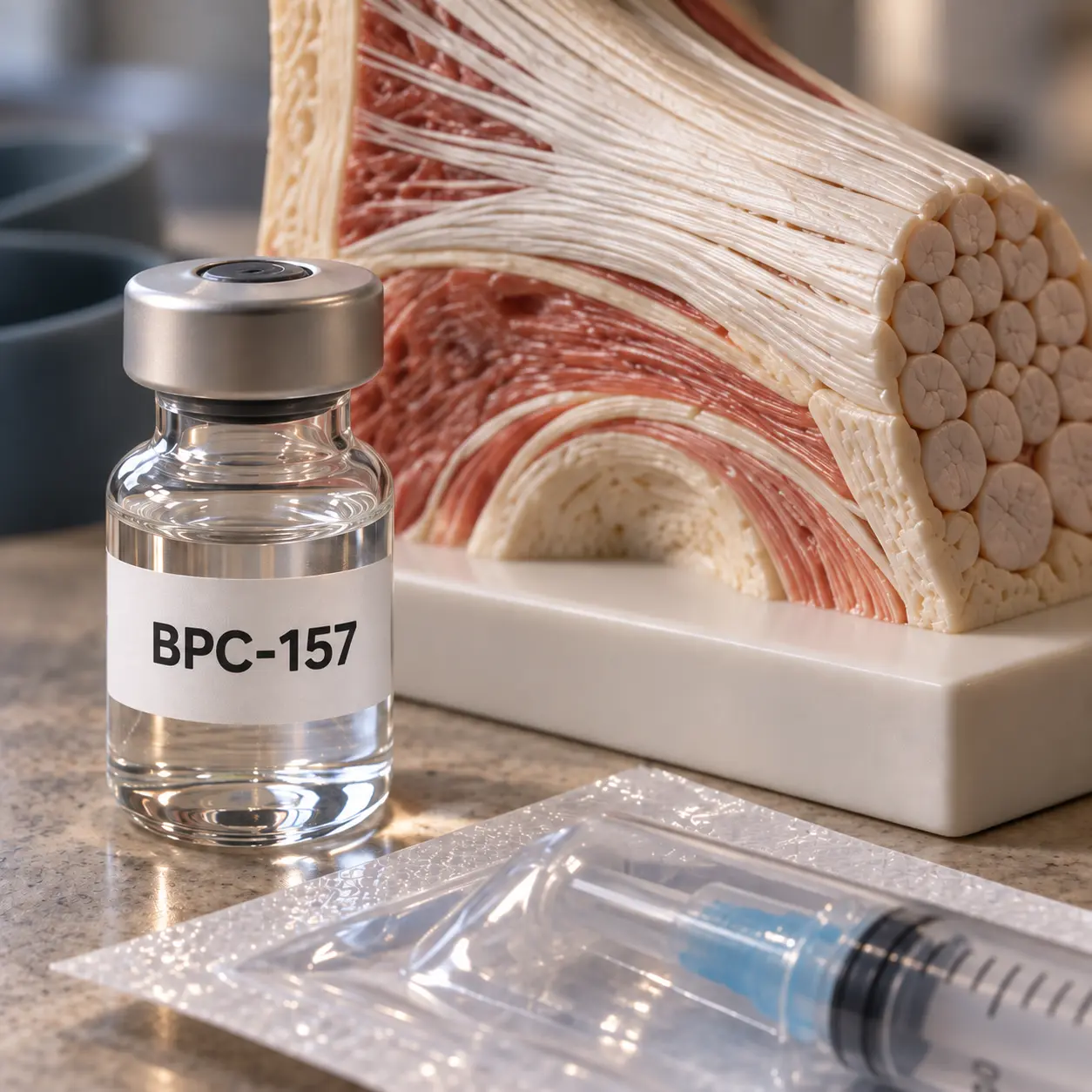
BPC-157 is a laboratory-made chain of 15 amino acids, based on a sequence found in a protein in gastric juice. Its promoters claim it speeds the repair of tendon, ligament and muscle injuries by encouraging blood vessel growth and better collagen organisation. Those claims rest almost entirely on animal experiments rather than on studies in people.
It is sold as a research chemical, as an injectable or as an oral capsule, through websites that operate outside medicines regulation. None of those products has been assessed by a medicines regulator for quality, purity or effect. The same evidence-first scrutiny is worth applying here as to any other popular compound, including supplements such as nicotinamide mononucleotide.
The marketing leans heavily on the name. BPC stands for body protection compound, and the peptide is described online as a natural healing agent because its parent sequence occurs in the stomach. Neither point tells a reader anything about whether an injected or swallowed synthetic fragment repairs an injured human tendon. A plausible mechanism is a hypothesis to be tested, not a result.
What the human evidence actually shows
As of 2026 there is no controlled clinical trial showing that BPC-157 heals tendons in people. A 2025 systematic review in the American Journal of Sports Medicine screened 544 records for orthopaedic uses of the peptide and found only 1 human clinical study fit to include. The other 35 studies it included were in animals.
The single published human report examined safety rather than whether the peptide works, and a safety pilot cannot demonstrate benefit. The reviewers were explicit that the human evidence base for orthopaedic use is effectively empty. More than 100 animal studies suggest BPC-157 helps tendons heal, yet not one controlled human trial has tested whether it works. Anyone claiming proven tendon healing in people is describing results that have not been produced.
Demand has run ahead of the science. Athletes, lifters and people with stubborn tendinopathies trade experiences on social media and in forums, and a strong personal account travels faster than a null trial. That is the mechanism by which an unproven compound becomes popular without ever passing a clinical test. It also explains why the absence of trials is not a technicality. On a question that affects how people treat real injuries, the missing evidence is the story.
Why the animal results have not translated
Across roughly 30 years, more than 100 preclinical studies in rats, mice and cell cultures have reported that BPC-157 accelerates the healing of tendon, ligament, muscle, gut lining and bone. In rodent models of Achilles and quadriceps tendon injury, treated animals recovered tissue structure and function faster than untreated controls, and several papers proposed plausible biological mechanisms for the effect. On paper that looks consistent, and it is the reason the compound has drawn serious laboratory attention rather than being dismissed outright.
The method is where it unravels. Most studies used injury models, doses and delivery routes chosen for the laboratory, not for clinical use, and many were small and not blinded. Rodent tendon biology differs from human tendon biology in loading, healing time and scale. A signal that is reproducible in a rat model is a reason to run a human trial, not a substitute for one. This is the ordinary pattern of early research into musculoskeletal regeneration, where most promising animal findings do not survive contact with a proper clinical study.
Context A 2025 systematic review in the American Journal of Sports Medicine identified just 1 human clinical study among 544 records screened for BPC-157 in orthopaedics, alongside 35 preclinical animal studies.
What the FDA panel vote in July 2026 changed
On 23 July 2026 the United States Food and Drug Administration's Pharmacy Compounding Advisory Committee voted 8 to 6 to recommend adding BPC-157 to the list of bulk substances that compounding pharmacies may use. The committee voted against the written recommendation of the agency's own scientists, who had reviewed the evidence and advised against it.
The distinction matters because compounding is not drug approval. Compounding lets a pharmacy prepare a substance for a patient without the manufacturer running the full efficacy and safety programme that approval demands. Adding BPC-157 to the 503A bulk substances list would permit that preparation. It would not establish that the peptide works, and it would not create a licensed product with an approved indication.
A recommendation is also not an approval. The vote is non-binding, and the FDA must still complete a formal rulemaking process, which typically runs 8 to 12 months, before any pharmacy would have clear legal authority to prepare the peptide. The agency then issues its own determination, and its scientists had already set out their reservations in writing, citing gaps in the safety data and the absence of adequate human evidence. BPC-157 remains unapproved as a medicine in the United States, and separately in the United Kingdom and the European Union, where no equivalent step has been taken. Approval, availability and legality differ by territory, and a vote in one country changes nothing about its status in another.
How BPC-157 compares with established tendon care
Set against standard care, the contrast is stark. Progressive loading and structured physiotherapy are supported by controlled trials and clinical guidelines for the common tendinopathies, and for many people they resolve the problem without any drug. Where a procedure is warranted, options such as extracorporeal shockwave therapy also carry published trial evidence, however mixed.
Against that stands an unapproved peptide with laboratory promise, testimonial and no human efficacy data, no regulated product and no clinical guideline. Cost and administration widen the gap. Physiotherapy is time and effort rather than an ongoing purchase, whereas the peptide is an open-ended spend on an unregulated product, often self-injected, with no assurance of what the vial contains. Tolerability cannot be compared honestly at all, because it has not been measured in a controlled human population. On the three measures that decide clinical value, evidence of benefit, a known safety profile and quality assurance of the product itself, the comparison is not close.
That is a statement about the state of the evidence, not advice for an individual injury, which is a matter for a clinician. It also sits within a wider pattern across regenerative approaches, where the science is moving quickly but the marketing frequently outpaces what any trial has shown.
The safety questions and the unregulated market
The strongest case against BPC-157 is not that it has been proven harmful. It is that too little is known and the supply cannot be trusted. Long-term safety in humans has not been characterised in controlled studies, so reported side effects rest on anecdote rather than surveillance. That absence of data is itself the concern, because it means unknown risk rather than demonstrated safety.
The market makes the problem worse. Products sold as BPC-157 online are frequently mislabelled, and independent testing of research peptides has repeatedly found material that differs from the label in identity, purity or quantity, sometimes with bacterial contamination or unlisted substances. A buyer cannot know what is in the vial, and an injectable prepared and administered without sterile technique carries infection and injection-site risk on top of the unknowns of the peptide itself. Because the product is unregulated, there is no batch record, no recall route and no accountable manufacturer if something goes wrong.
The peptide has also been on the World Anti-Doping Agency prohibited list since 2022, so any athlete using it risks a sanction regardless of the clinical debate. Anyone who has taken an unregulated product and felt unwell can report it through the MHRA Yellow Card scheme, and should speak to a pharmacist or doctor rather than a supplier.
What remains unknown is whether BPC-157 does anything for human tendons, because the trials that could answer it have not been run. Settling it would take adequately powered, randomised, placebo-controlled studies with objective tendon healing endpoints, pre-registered and published in full. Until those exist, the animal data cannot be read as evidence of benefit in people. The nearest regulatory milestone is the FDA's rulemaking on compounding, expected to take many months, after which the agency will issue its own decision. The peptide remains unapproved as a medicine and prohibited in sport. Anyone weighing it for a tendon injury should discuss the evidence, and the risks of unregulated products, with a doctor or pharmacist.
Written by Tom Okafor, clinical trials correspondent, and reviewed for clinical and regulatory accuracy by Dr. Eleanor Vance, specialist in regulatory affairs and market authorisation, on 8 September 2026. Review date September 2026, next scheduled review December 2026. This article is evidence analysis for professionals and does not constitute medical advice. Corrections are appended and labelled, never made silently.